


As we get closer to December, you may find yourself thinking about the charitable gifts you’d like to make before year-end.
A check to a favorite charity. A donation in memory of someone special. A gift to the hospital that cared for a loved one, the school that opened doors, or an organization that’s been part of your family for decades.
Giving isn’t just a financial decision. It’s personal. And how you give can affect the tax treatment of your gift.
If you’re age 70½ or older and planning a charitable donation, a Qualified Charitable Distribution (QCD) from an eligible IRA may be worth considering, even if you aren’t yet required to take withdrawals.
Give From Your IRA Tax-Free
A QCD generally allows an eligible individual who is at least age 70½ on the distribution date to direct money from an eligible IRA to an eligible charity.
For 2026, the annual federal income exclusion limit is generally $111,000 per eligible individual across all of that individual’s IRAs, subject to applicable requirements and adjustments. A qualifying QCD can also count toward your IRA required minimum distribution (RMD) for the year.For most current retirees, RMDs begin at age 73, but QCDs are available starting at 70½.
Why the Way You Give Matters
Consider an illustrative example of two eligible retirees who each plan to give $10,000 to charity using fully taxable traditional IRA funds.
Retiree A receives a $10,000 IRA withdrawal and then makes a cash gift. The withdrawal generally adds $10,000 to income. A charitable deduction may be available, depending on the retiree’s circumstances and applicable limits.
Retiree Barranges a $10,000 transfer directly from the IRA custodian to an eligible charity. If all QCD requirements are met and no adjustment reduces the exclusion, that $10,000 can be excluded from income. The excluded amount cannot also be claimed as a charitable deduction.
Retiree A reports $10,000 more income; Retiree B reports none — and still keeps the full standard deduction.
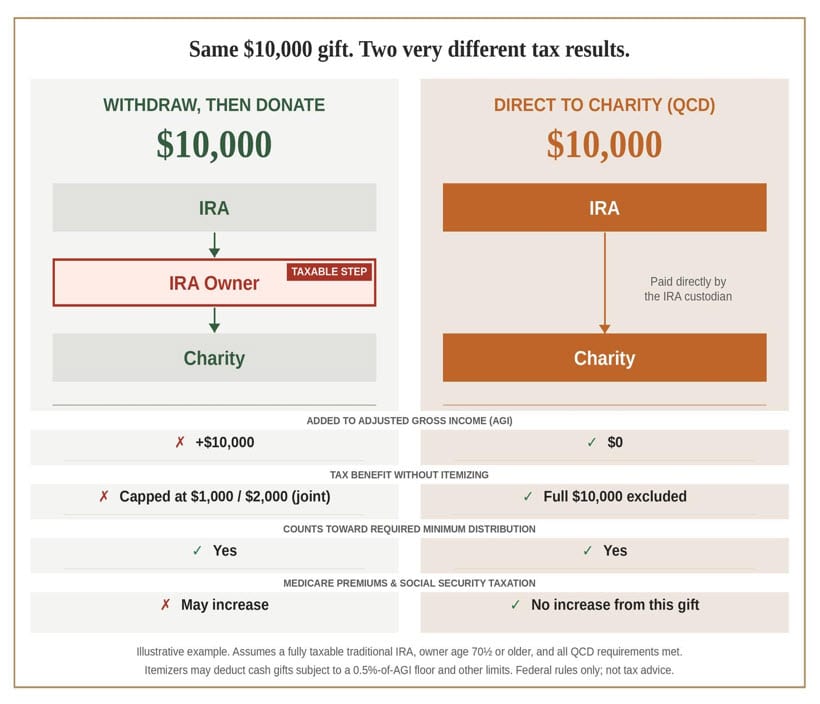
For 2026, eligible non-itemizers may deduct up to $1,000 of qualifying cash gifts, or $2,000 if married filing jointly. These are below the line deductions and does not lower AGI. It also does not apply to gifts to donor-advised funds or private foundations. A QCD does lowers AGI. Itemizers generally face a new charitable-deduction floor of 0.5% of adjusted gross income, along with other applicable limits. For taxpayers in the top bracket, itemized deductions after 2025 produce a tax benefit of only 35%, not 37%. The better approach depends on your individual circumstances.
A Potential Benefit Beyond the Donation
Compared with taking a taxable IRA withdrawal and then donating the proceeds, a qualifying QCD may help:
- Keep the qualifying IRA distribution out of federal adjusted gross income.
- Limit exposure to income-related Medicare Part B and Part D surcharges. Medicare generally uses income from two years earlier, and a QCD does not guarantee lower premiums.
- Reduce the portion of Social Security benefits subject to federal income tax, depending on your other income and benefits.
- Provide a federal income exclusion without requiring you to itemize deductions.
- Lower AGI can also reduce net investment income tax (NIIT) exposure, help preserve the $25,000 rental-loss allowance, and lower state income tax, especially in states that don’t allow itemized deductions.
These potential benefits depend on your income, eligibility, and other tax circumstances.
A Few Important Requirements
QCDs must be paid directly from a traditional IRA (or an inherited IRA) to a qualifying public charity. They can’t come directly from a 401(k) or an ongoing SEP or SIMPLE IRA, although those funds can first be rolled into an IRA. Donor-advised funds, supporting organizations, and private non-operating foundations don’t qualify. Get a written acknowledgment from the charity confirming that you received nothing in return; receiving any benefit can disqualify the entire transfer.. Deductible IRA contributions made for years in which you were age 70½ or older may reduce the amount eligible for exclusion.
QCDs are generally best made from a traditional IRA. Roth IRA withdrawals are typically already tax-free, so a QCD from a Roth usually provides no added benefit.
Other ideas worth considering:
- The one-time split-interest election. A donor can make a one-time QCD of up to $55,000 in 2026 to a charitable remainder trust or charitable gift annuity. The vehicle must be funded only by QCDs, a gift annuity must pay at least 5% within one year, and only the donor and/or spouse may hold the income interest.
- Inherited IRAs. A beneficiary who is 70½ or older can make QCDs from an inherited IRA.
- Basis ordering. For clients who made nondeductible IRA contributions, a QCD is treated as coming from taxable amounts first. That is more favorable than the normal pro-rata rule.
Let’s Take a Look Before Year-End
Timing matters. A QCD must be completed by December 31 to qualify for 2026. A withdrawal already paid to you cannot be retroactively redesignated as a QCD, so allow time to confirm eligibility and your IRA custodian’s processing requirements. Be sure to tell your tax preparer about any QCD and give them the charity’s acknowledgment
Whether you still have an IRA RMD to satisfy or are exploring how to make your charitable gifts, be sure to reach out to us.